Well, it’s that time of year again, the daylight is getting shorter, the temperature is getting cooler, and the bees are out in force! With this rise in bee activity, we also see a rise in allergic reactions. As a fairly avid local scanner page follower, I have seen emergency calls for allergic reactions to bee stings almost daily. Whether we are at playgrounds, gas stations, sporting events, schools, or even in our own backyards, no one is safe! With this in mind, I had two encounters with people in the last week relating to bee sting allergies. The first one was with a man who is a retired state conservation warden. He told me about his bee sting (Hymenoptera) allergy, and that he always carried his epi with him. He also told me that there is more than one type of bee venom. This wasn’t a surprise to me, because I have been stung multiple times over the years without incident, but there was one time that after I was stung, my feet itched like crazy for almost an hour.
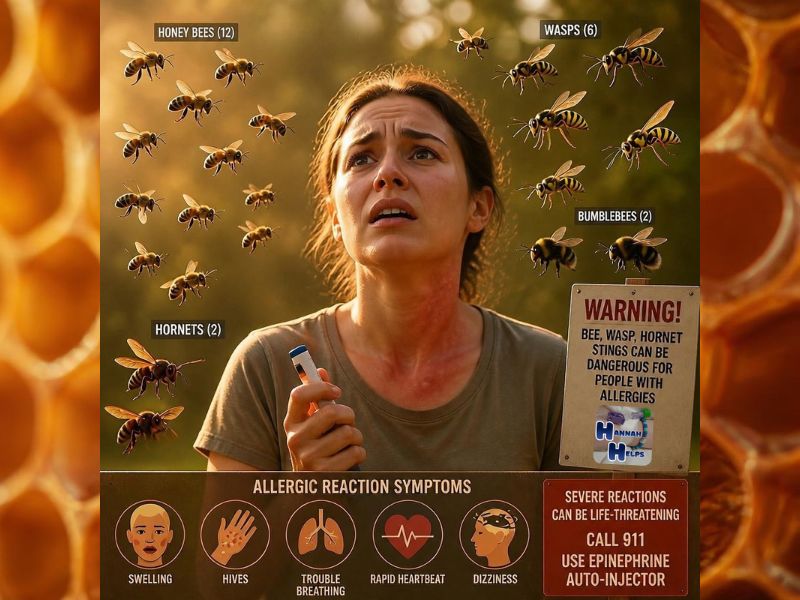
After this conversation, I began to wonder, “how many types of bee venoms are there?” I found this surprising information on the ECARF website, “Allergic reactions to insect venoms are triggered by proteins in the venom. Twelve bee venom allergens, six wasp venom allergens, two bumblebee venom allergens and two hornet venom allergens have been identified so far.” So, by my math, that would add up to twenty-two individual potentials for an allergic reaction! This is a warning to the wise, just because you have not had an allergic reaction to a bee sting yet, don’t assume that you are completely safe. I am also reminded that Dillon Mueller lost his life at 18 to a bee sting. This was not his first sting, but it was the first one that he was allergic to, and the consequences were tragic!
A few days later, my second conversation was with a young man in his early twenties. After I mentioned that the bees were going crazy, he told me that he was already on the lookout for them because he was allergic to bees. Then I asked him if he had his epi with him, and he said NO. He told me that his plan was to drive himself to the hospital if he was stung. I told him that there was a good chance that he would not be able to safely drive, or that even if he could start the drive, he would not make it there. Then he told me that he was really not comfortable with giving himself a shot. So, I told him about Neffy being a nasal spray, but that still didn’t really change his mind. He just wasn’t too worried about it… In conclusion I told him that since we lost Hannah to an allergy, he was not going to get any support or sympathy from me for his carefree attitude about his bee allergy.
Whether it be insect stings, foods, or any other type of allergy, being prepared is the key! For those with known allergies, preparation means that you have that epinephrine with you at all times, and that you know when to use it (if there is tightening of the airway, if the cardiovascular system is being affected, or if two systems of the body are being affected). For the rest of us, preparedness means that we get our own epinephrine, carry it, and live prepared to save the lives of those around us. If you would like to learn more about bee stings, here are two links to more information: ECARF and Science Direct .
We are blessed
P.S. We can’t do this alone. If you would like to donate to Hannah Helps:
PayPal: paypal.com/us/fundraiser/charity/5609126
Venmo: venmo.com/u/hannahhelps19
Your support is needed and greatly appreciated!
Thank You!
 Hannah Helps Blog