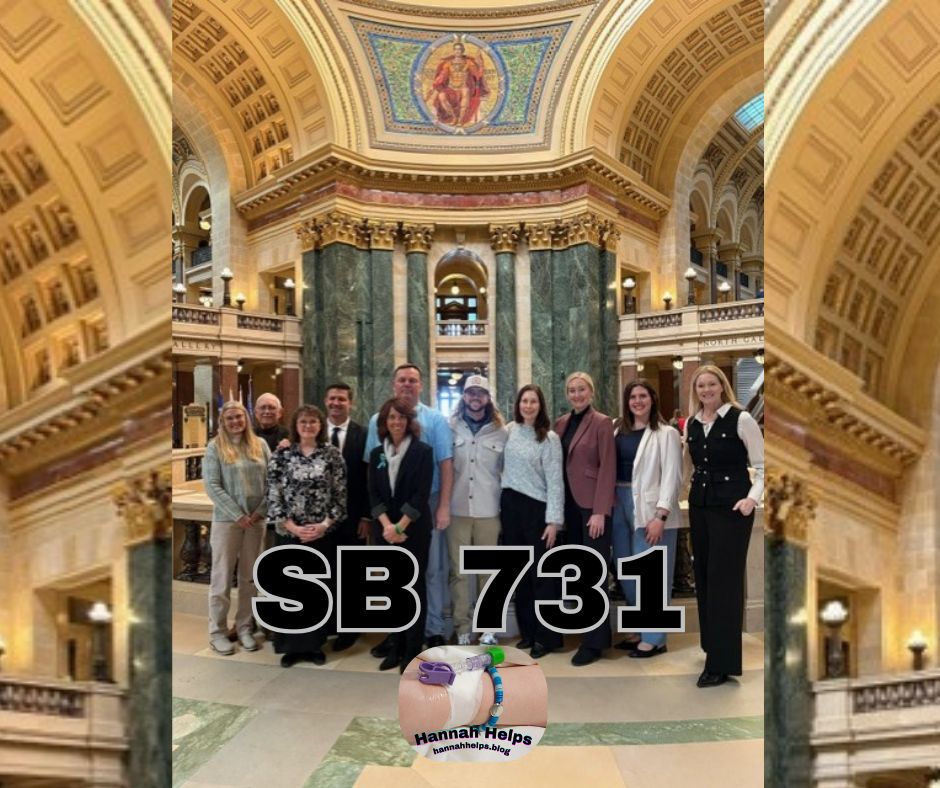
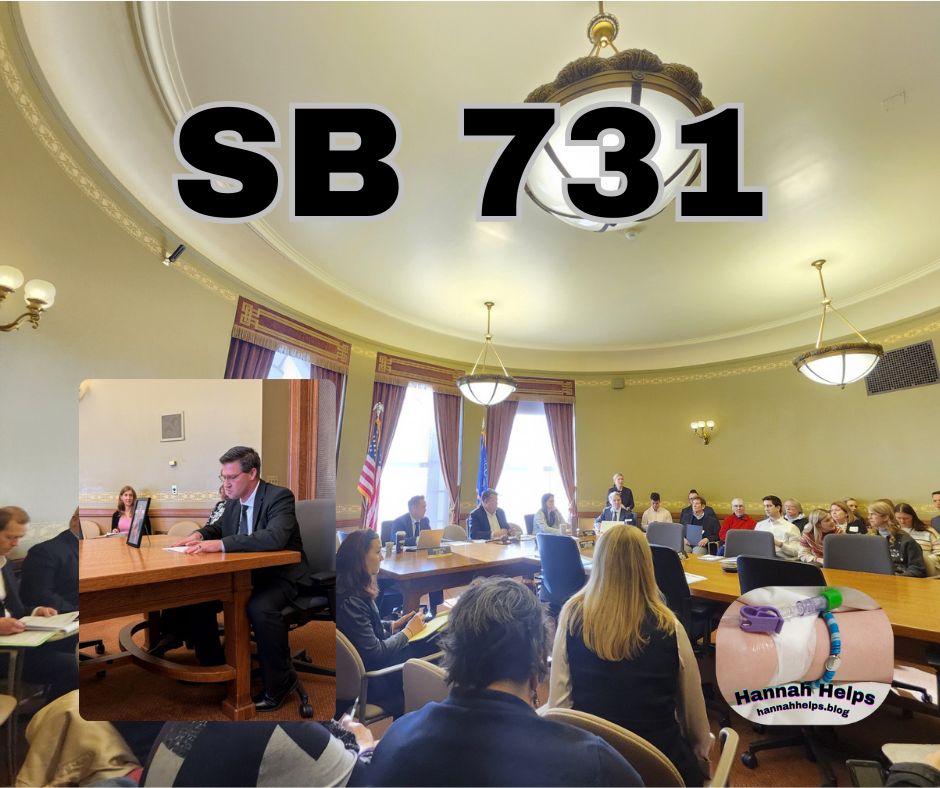
Last Wednesday we were back at the Wisconsin State Capital to share Hannah’s Story. This time we were speaking to the Senate Committee on Education in support of SB 731, the sister bill to AB 749. It was a typically cold Wisconsin January morning, in fact, as we walked past the back of a restaurant near the capital, a man came out and dumped a bucket of ice into the gutter, and it was steaming because the outside air was so much colder! The inside of the capital was quiet but getting busier with visitors and school groups. There is one-third of the number of Senators (33) as there are Assembly Representatives (99), since each Senator represents three assembly districts. This means that the committee itself was proportionally smaller than the Assembly Committee on Education, and the meeting room itself was smaller too. The Senators were very busy, and some of them came in and out as was necessary to meet their other obligations around the capital.
SB 731 would require schools in our state to provide some form of education on organ and blood donation during a student’s high school years. This education used to be taught through the driver’s education classes offered in public schools, but now many of those classes are no longer offered. Also, kids are taking online or private driving instruction instead, and a large percentage of sixteen-year-olds do not even get a driver’s license. So, although these kids can choose to become organ donors at sixteen, they may not ever have been educated on that decision. The timing of the instruction, the manner of the instruction, and even the length and amount of the instruction is subject to the individual control of each school board. Versiti and other organizations do offer free educational information, so complying with this law could be as simple as a student watching a thirty-minute video, prepared by one of these organizations, as part of a health class only once during their four years of high school. The only opposition that we hear about is from the teacher’s union. They do not want any more work for their teachers, but their representatives left the room before our bill was presented. Their objections and opposition seem to be minimal, and it is anticipated that this bill will pass the full Senate and be signed into law by Governor Tony Evers.
Our bill was the last to be heard, and then we had to wait a couple of minutes for the author and sponsor of the bill, Senator Testin (Yes, the same Senator that sponsored AB 128 for us), to run through the capital and present the bill. I spoke after him, followed by the team from Versiti. Then a donor mother was next. Her daughter passed away in a snowmobile accident but had chosen organ donation for herself. Finally, Dick, a double lung recipient, closed us out. He provided the healing side of organ donation.
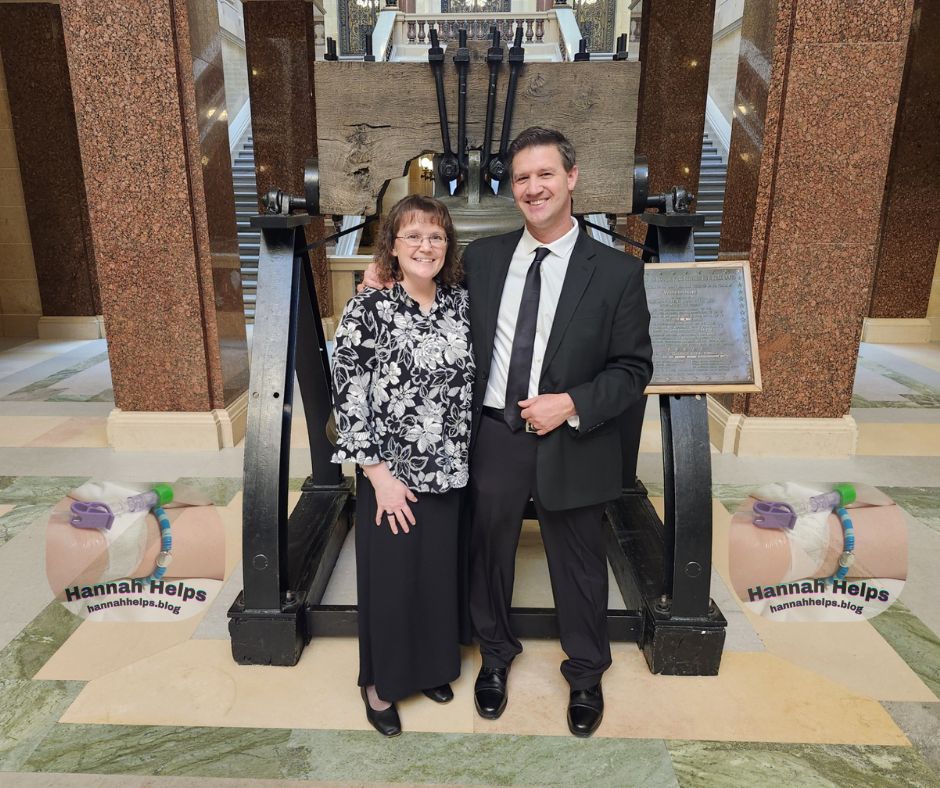
These sessions are not recorded, as AB 128 was, because of budgeting issues. Janean and I sat together and I read Hannah’s Story. We had one of Hannah’s senior pictures with us and we set it on the table so they could see her. Her story pretty much speaks for itself. After I finished, the room was incredibly quiet. Senator Keyeski was trying not to cry too much, and Senator Jagler (chairman) was the first to speak. He thanked us for sharing her story, he expressed his condolences for our loss, and he briefly shared a personal connection that he has to organ donation. His father had a lung condition and needed a double lung transplant thirty years ago. As his father’s health deteriorated, they eagerly waited for that life-saving gift. At that time Senator Jagler worked as a news anchor for a local radio station and each time that he reported about the loss of a life, he wondered if maybe his dad’s life might be saved. One day he heard about a motorcycle accident, and a short time later his dad “got the call” and received his Gift of Life. Senator Jagler shared that they all felt the weight of the loss too. Although they knew it was a priceless opportunity for them, they also grieved because they knew that it was a tragedy for someone else and another family. I told him that although we were hurting deeply, we were thinking of our recipients too as we said goodbye to Hannah. Senator Keyeski expressed her condolences and thanked us for sharing Hannah’s Story, as she dabbed her eyes and nose with tissues. It was a good visit, and we are happy to share Hannah’s Story wherever we can.
Here is what we said:
The life of Hannah Glass was marked by determination, hard work, and a love for education. She was a virtual school student with a life’s dream of going to college. Once she turned sixteen, she began working hard to achieve that dream. Hannah would wake up early, do school for a couple hours, go to work as a waitress or CSM at Hobby Lobby, then come back home to complete her assignments. She took dual enrollment classes in her last two years of high school and also during the summer and Christmas breaks. Hannah loved the education, the work, and the personal responsibility. A year ago, her dream came true as she became an on-campus dorm student for the first time. She majored in Secondary English Education and chose Teaching English as a Second Language as her minor. Because of those prior efforts in school and at work, she started her first year on campus as a second semester sophomore with enough money saved to pay for her full four-year education!
Hannah loved college life, but the night after her nineteenth birthday, she swallowed just one bite of a gluten-free brownie that was given to her by a friend as they met to study in the library. Later we learned that it contained refined peanut flour, which made the peanut undetectable. We knew that she had a peanut allergy, but it had never been a big deal. We had only encountered it twice in her life, at ages three and six. Each time these episodes were mild and brief. We did go to an allergist and there she received her first EpiPen. Over the next thirteen years she became an adult, and we never had any issue with her allergy. BUT that Monday night, after she realized that something was wrong, she ran back to her dorm, threw up, and called us to come and be with her. She did not take her epinephrine though because she felt that she was “OK.”
We kept her on the phone as we raced to her side, and her reaction seemed to be over with by the time that we arrived in Watertown forty-five minutes later. But the situation took a drastic turn when she laid down to rest. At that point, she began to have sudden difficulty breathing, and then she passed out as she was climbing out of bed. We gave her epinephrine and called 911 immediately. Then I picked her up like a big limp rag doll and carried her outside to the arriving ambulance. I briefly sat her on my knee, facing me. I had one arm behind her back and the other hand at the base of her head, to hold it up. It was the most helpless feeling that a parent could ever have! As I looked at her lifeless face only inches from mine, I thought, “Is this really happening!? Is Hannah really dying in my arms!?” All I could do was to tell her that we were there, that we loved her, and that it would be “OK.” After I handed her off to the EMT’s, they took her quickly into the ambulance, but once inside, her heart stopped for several minutes. They were able to restart it, but her blood oxygen level remained dangerously low, and then for the next two and a half hours the doctors at the hospital tried to figure out WHY it was so low. Shortly after midnight they found that her right lung had collapsed. They quickly reinflated it and then she was transferred to Froedtert Hospital in Milwaukee.
At six in the morning, we got our first real update on her condition. They were keeping her alive, but there was extensive brain damage! Only time would tell how bad it really was…
Like most people, I had heard about organ donation, but it was never something that I seriously considered. It’s not really a situation that anyone expects to be in, but two days later, as we waited in the hospital, I got a text from my cousin. He was at Froedtert too, but for an appointment of his own, and he asked to meet with me. He was a big, tall, strong guy and someone that I always respected, but as I walked into the cafeteria that afternoon, I saw that things had changed drastically. He was in a wheelchair, on oxygen, and had difficulty standing. He told me about the sudden onset of his lung condition and that he needed a double-lung transplant. His only hope was organ donation! As I talked with him and his wife and then thought about their family, God helped me see the other side of organ donation. After our conversation, I shared these things with Janean, and we tucked those thoughts away in the back of our minds while we waited and prayed for Hannah’s recovery.
As we stayed by her side, we longed for her eyes to open, but Hannah never came back to us that week. Then late on Friday night, her heart began to slow way down from the swelling of her brain. More testing needed to be done, and as we waited in the darkness of that hospital room, realizing that we could be near the end of her life, Janean asked, “How are we ever going to survive this?” The response that God put in my mind was, “We need to Do Right: We will Breathe, Take small steps, and Keep moving forward.” Moments later, when we saw the doctor rolling a chair in to talk to us, we already knew what he was going to say… He was about in tears as he told us the obvious truth of the situation. She was about to die and there was no more hope! It was at that point that we chose organ donation for our daughter.
So, on Sunday November 3rd we celebrated Hannah’s nineteenth birthday and one week later on Sunday November 10th, we held her honor walk and said our final goodbyes outside the operating room doors. At 3:57 our daughter’s life ended, but the lives of four recipients began again, two more received the gift of sight, and many more have been impacted by her life and our decision!
Organ donation isn’t something easy to talk about. Death, loss, and separation can create an incredible amount of apprehension for the donor while vulnerability, embarrassment, guilt, and shame can plague the recipient who understands “the price that was paid” to save their life. It’s a situation that no one wants to be in. But, despite the fear and emotions, one simple, foundational truth outshines them all, “Organ and blood donation SAVES LIVES!” We are supporting SB 731 today because we understand that saving lives begins with education.
Just a few hours before that tragic bite, Hannah told a friend that she wanted God to use her life in an effective and meaningful way. Through her life and now her passing, He has been doing just that. The beauty of a rainbow can’t come without the rain, and thanks to organ donation, we were able to add that type of beauty on to a very dark cloud in our lives.
We are blessed.
P.S. If you would like to donate to Hannah Helps:
paypal.com/us/fundraiser/charity/5609126
 Hannah Helps Blog