
The other day we went on a school field trip. Following the activity, we stopped at a local Culvers for lunch. When we walked in, we saw a good friend who we don’t see too often, since our lives have gone in separate directions. She was now working there at the restaurant. It was good to see her, and when the opportunity presented itself, we were able to have a few minutes to talk to each other. We haven’t seen her since before Hannah passed away, but she was very aware of it and was trying not to cry as we spoke together. She was deeply impacted by Hannah’s passing and brought it up almost immediately. It was a good heart felt conversation and a good time of “catching up” with each other.
Later, after we got home, we began thinking about our visit, and specifically the way in which these times of remembrance seem to pop up out of the blue and all of a sudden. The question arose, “Should the loss of our daughter always be the first thing on our minds?” When we walked in that day, our minds were on the educational trip that we had just been on, touring an old local landmark. She was in the restaurant already, and her mind was on the responsibilities and duties that she had. In analyzing the way in which these things take place, we came to a realization that remembering begins with memories and reminders of those memories. Yes, this is obvious when thought about, but it isn’t too often that we take the time to examine the way in which these things happen. As we see people, our minds go through a series of questions. Basically who, what, when, where, why, etc., or the “W” questions. Our minds race to figure out who it is, how we know them, how long it has been since we last had contact, and, for a lack of a better word, what “news” has taken place since we last had contact. Generally, we say that these meetings are a time to “catch up”. We “catch each other up” on the important “news” that has taken place in each of our lives.
We did not know that she worked there, but when we saw her, our minds were racing to answer those “W” questions. We established who she was, how we knew her, when the last time that we saw her was, etc. Then we began to formulate thoughts, ideas, and questions based on what we knew of her from the past, what we had heard about her from others, and what we could deduce from her standing right there in front of us. She was the object of our attention, and as a good friend, we were looking forward to getting the opportunity to “catch up” with her. That was our perspective, and it quickly moved from our field trip, to what we were going to get for lunch, and then to her. She, on the other hand, was at work. Her thoughts were on serving others at the restaurant. Then she saw us walk in and it was as unexpected for her as it was for us. Her mind began racing through all the same questions that ours had, and she too began to remember, process what she knew had happened, and she began to formulate her own thoughts and questions for us.
Neither of us was thinking about the other in the moments leading up to our seeing each other. Each of us was busy with the responsibilities that we had, but as we saw each other, she immediately thought of Hannah, and we did not. For a moment, we felt almost guilty for feeling that in some way we had “forgotten Hannah” or have, perhaps, “moved on” too quickly. Then the question came, “Should the loss of Hannah always be the first thing on our minds?” “Was she remembering Hannah more than us?” Although it seemed a bit wrong at first, we began to realize that, as I said earlier, remembering is about memories and reminders of those memories. When we saw her, we were remembering and thinking about her. Hannah was part of our relationship, but she was in no way the primary link between us. We remembered the times that we shared together, and we were interested in her and the life that she has had since we last spoke together. She, on the other hand, remembered us initially from our past, but her mind quickly moved to this obvious tragedy in our lives. Her heartfelt sympathy was very touching, appropriate, and appreciated.
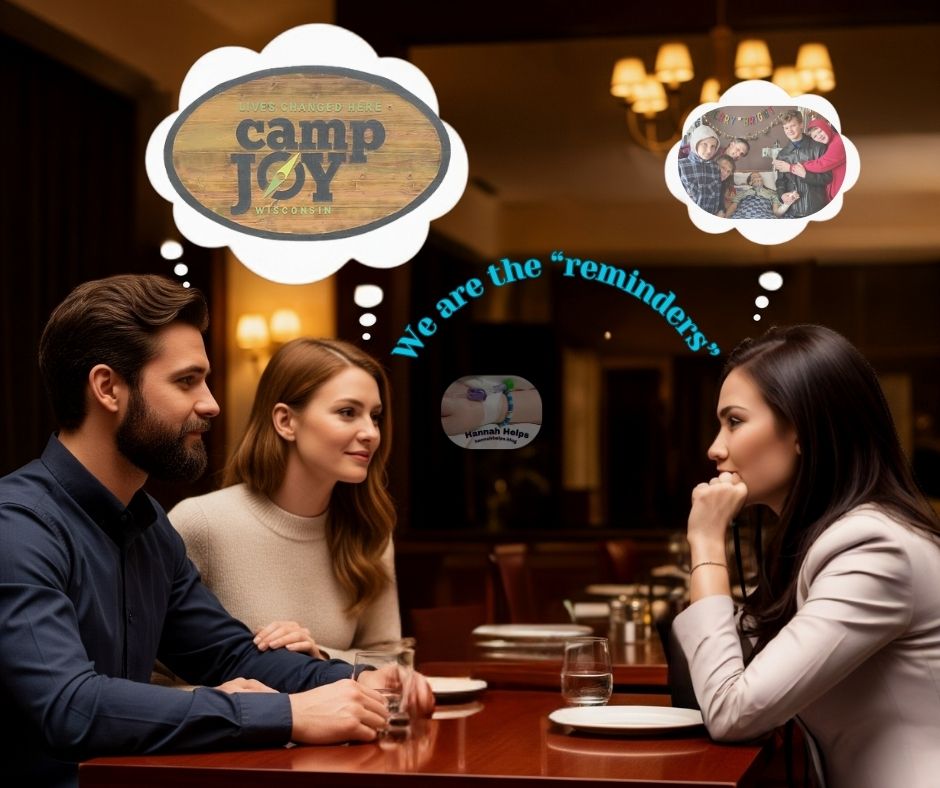
So, remembering is about memories and the reminders of those memories. We have lots of memories of our daughter, but this friend is not one of them. As I said earlier, Hannah was not the link tying us together in our relationship. If this was a friend that Hannah had through work or school, then Hannah would have been the first thought on our minds. When we saw this friend, however, we thought only of her, because she didn’t immediately remind us of Hannah, but, on the other hand, for her, WE were the reminder of her memory of Hannah because Hannah was our daughter. Seeing us immediately made her think about Hannah, not because she was in some way “remembering Hannah more,” but because she was reminded of Hannah’s passing because she saw us. We can feel no guilt in remembering the joys of lifelong friendships in moments like these, over remembering Hannah. Her passing can’t be the first and defining thing that we discuss with everyone that we meet. BUT, on the other hand, we have learned too that WE ARE THE REMINDER to others, and as such, we need to try to be aware and sensitive to the fact that when we meet old friends, although we may be thinking about the joys of our friendship with them, they may be feeling the sorrow of our loss in that moment. The sorrow is the same, but the reminders are different. We are blessed to have friends like this.
I apologize for the length of this, but I also need to mention that our friend Joan, the one that we went to visit a few days ago, passed away today. She was a blessing to all of us and she too will be missed until that day when we all meet again in heaven. Congratulations on the promotion Joan, and please say” Hi” to Hannah for us! May His peace be with her family at this time.
Life isn’t easy, but still, We are blessed.
 Hannah Helps Blog