An hour after our last post about meeting our second organ recipient and two women in the organ donation outreach department with UW Health, we did a video conference with a representative of the Asthma and Allergy Foundation of America. According to their website, aafa.org , “The Asthma and Allergy Foundation of America (AAFA), a not-for-profit organization founded in 1953, is the leading patient organization for people with asthma and allergies, and the oldest asthma and allergy patient group in the world.” For the first twenty years or so, they focused only on allergies, but then in the ‘70’s, they added asthma to their name and mission because these two, though different, are often connected.
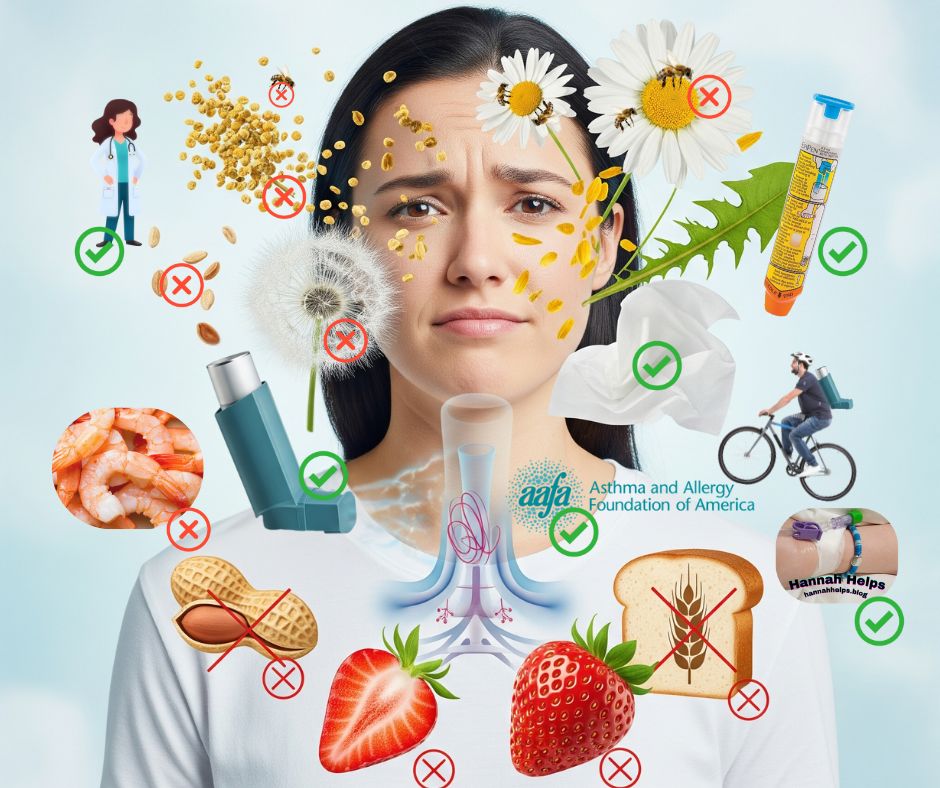
Hannah, like many other allergy sufferers, also had asthma. About 1 in 13 people in the US have asthma according to the National Heart, Lung, and Blood Institute. Asthma is an inflammation of the airways which leads to coughing (especially at night), a tightening of the airways in the chest, wheezing, and difficulty breathing. An inhaler is often used to help open up those airways, but in more severe cases, a nebulizer will also be used. Allergies can cause asthma, and this is called “allergic asthma,” but there is also “non-allergic asthma” too. Causes of non-allergic asthma would include things like respiratory infections, stress, cold, physical activity, and smoke. One day our son, Robert, who has asthma too, said, “You guys are lucky. You can just breathe.” It made me stop and appreciate how big some of the simple things really are that many of us take for granted, just breathing. Although most of us know people with asthma and it can often seem “harmless,” we do have a friend who lost her son to an asthma attack. They were both at home, he was just in the other room, and it was silent. She had no idea that there was a problem, until she found him. Yes, it can really be THAT serious!
Almost 26% of adults in the US have at least one diagnosed allergy. Allergies are the body’s immune system overreacting to something that should otherwise be harmless. When things like pollen, dust, a bee sting, or foods such as peanuts, tree nuts, or shellfish come into contact with the body, the immune system can begin an all-out assault mode. In severe cases, that assault can jeopardize the life of the allergy sufferer. Asthma and the respiratory system can be triggered by this reaction, but other systems can be affected too like the cardiovascular, gastrointestinal, and mucocutaneous systems, and even the integumentary system which includes the skin. Most allergies, especially seasonal allergies, are common and often not serious. These are often treated with antihistamines, steroids, Benadryl, nasal sprays, eye drops, and over-the-counter medications. But allergic reactions can also be VERY serious! An inhaler may help somewhat with the asthma related symptoms of an allergic reaction, but it will not stop the reaction. If the person is experiencing difficulty breathing, swelling in the throat, or dizziness, or if two systems of the body are visibly affected by the allergic reaction (such as vomiting and rash), the person needs to use an epinephrine auto injection device, commonly called an “EpiPen.” This shot of epinephrine may end the reaction or just pause it, but it at least will help “buy time” for the patient to be able to get immediate medical help. Most patients with severe allergies are given two “EpiPens” in case one is not enough. Both of them should be carried and both can be used if necessary. We did hear this week of a man, 35, married, and with four children, who was stung by a bee while grilling. He had a bad anaphylactic reaction then went into cardiac arrest. The last report we heard was that he was in very critical condition.
So, again, they can appear to be similar, but asthma and allergies are different, and they each are treated differently too. An allergist can help diagnose and treat each of these conditions. The AAFA website is also a valuable resource in learning more about both of these, and it also has a great section called, “Kids with food allergies.” They look like a great organization, and we had a good interview with one of their community outreach specialists. We spoke with her for about ninety minutes. We shared Hannah’s story, talked about things that we would like others to know about these subjects, and also explained what Hannah Helps is and what we intend to do in the future. The interviewer is going to spotlight “us” in an upcoming community profile on their blog site and we are looking forward to seeing what God will do there. This interview was similar to the Fox News Digital interview that we did several months ago. We will post a link to this “spotlight blog” when it comes out and we have already added the links to the AAFA home page and the page for kids too here on our website in the Link tab. Well, it seems that there’s always something happening around here! We can see that something larger than us is taking place and that we are being used by Him to help others in ways that we never would have been able to think of ourselves. Yes, just like before her accident, Hannah Helps!
We are blessed.
 Hannah Helps Blog