
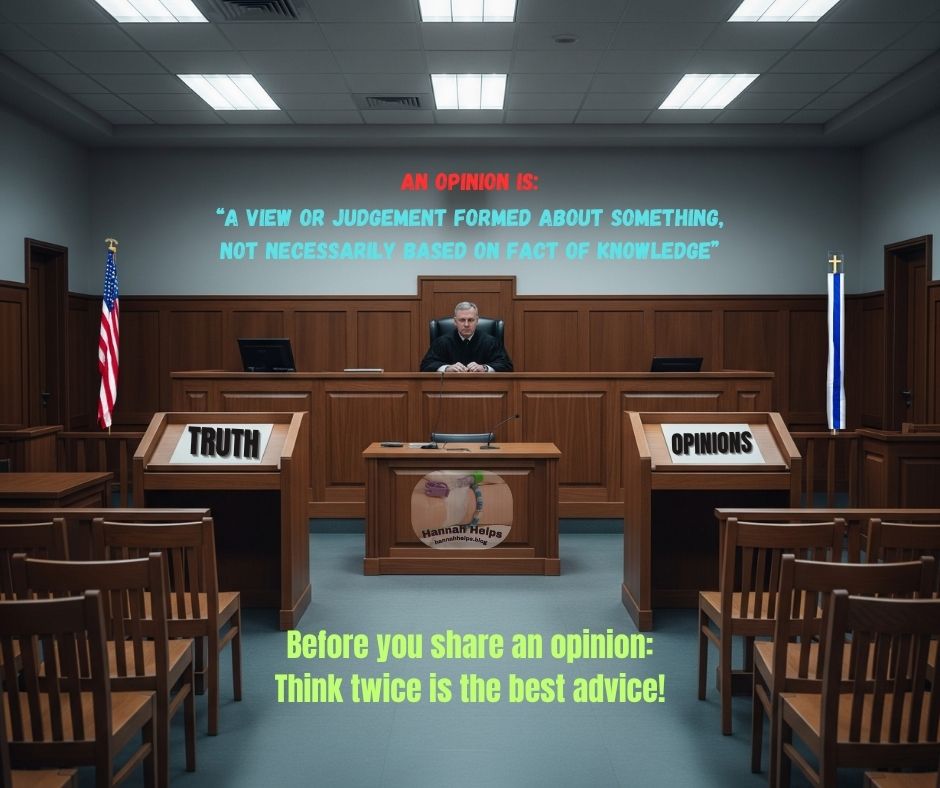
Since we are here on Facebook, and clearly, we are all “friends” here on the page, I would like to consider the topic of “opinions”. I would like to address three things primarily: the formulation of an opinion, the strength of the opinion, and the way in which we share or sometimes “inflict” those opinions on others. Let’s begin with the Oxford Dictionary definition. An opinion is, “A view or judgement formed about something, not necessarily based on fact of knowledge”. (Well, for those who are not yet offended, we will press on.) This seems like a pretty good working definition. As we all know, we all have opinions. Most are good, but admittedly some may not always be true or correct from time to time. No worries, that is part of being human.
I am thinking that the formulation of opinions can come from at least three sources: things we are taught by others, things we experience, and maybe things that we research/teach ourselves then choose to believe. As we grow, we are taught many things from academics, to not running with scissors, all the way to letting sleeping dogs lie, and my personal favorite, “don’t feed the bears”. (There is a rabbit trail here that will have to wait for another post.) These opinions can be based on the trust that we place in others and their guidance, which is based on their education and experiences. We next form opinions based on our own personal experience. For illustrative purposes I will admit that the best part of a black olive is the hole in the middle. My wife loves all olives, but based on my personal experience, they are gross. Further alienating myself from “normal humanity”, I do not like mushrooms. I can tolerate them in small quantities on a good pizza, but in general they are a fungus, which in my crazy mind, makes them a cousin of athlete’s foot. This is my opinion…. don’t judge me. LOL. So, those are opinions based on my experience. They can be “right for me” but not for everyone else. Finally, we can formulate opinions based on things that we research, see in someone else’s life, or even just hear about. These things may or may not be true and admittedly, could be right or wrong. Depending on the credibility of the source, the facts behind what we “see”, the amount of evidence provided, and an understanding of opposing viewpoints, we may not know the “truth” behind these opinions from firsthand experience. We have all been reminded of this in this last election cycle as ads ran for weeks full of whispers of “misconduct”, implied intentions, and selected audio clips likely taken out of context. Research is a very good way of gaining knowledge as long as the information is complete and accurate. Experience is also good, but the “school of hard knocks” can be a slow and painful teacher. Personal experience does give a strong basis for an opinion, but both proper education and research can help us avoid mistakes, and that makes the “experience” of life easier. As Solomon said in Proverbs 22:3, “A prudent man foreseeth the evil, and hideth himself: but the simple pass on, and are punished.” As we learn from teaching and then begin to learn from researching, we can “foresee” things, then make wise decisions, and ultimately avoid pitfalls in life, but that being said, not all things we learn or research are always correct.
With this in mind, let’s move to my second point, the strength of our opinions. Certainly, opinions gained from personal experiences are typically very strong in our minds. They are based both on us doing something and on us seeing the direct results of our actions. Maybe it’s like touching a hot stove. A mom may have told her child to keep their hands away from the stove many times (teaching), but if the child actually touches the stove and gets a burn on their finger, suddenly the lesson is learned, and the opinion formed immediately is that, “I should not touch the stove”. I think that personal experience will always be the strongest of opinions. I have noticed though, that sometimes people have different reactions to seemingly the same circumstance, and formulate two opposing opinions, neither of which is open to discussion or change. But can they both be right? Maybe, given the proper conditions and situations. As we move into the strength of our opinions based on things we research, we need to examine the sources of information, the quality, and the quantity of information. Specifically, I am saying that the less reliable the source is known to be, the less thoroughly we are in researching, and the less information that is available, the more careful we should be in formulating an opinion, especially a strong one. We, further, need to recognize that when there is limited quality and quantity of evidence from sources that we do not have firsthand experience with and the information given is “third hand” at best, we need to be very careful on how strongly we hold to our opinions. To be clear, we need to be very careful when we formulate strong opinions based on a YouTube video, a Facebook post, or even hear say from a friend. Even if true, the things said may be “outliers” and not the norm. I do not gamble, but I would guess that many of us have heard the idiom, “Hedging our bets”, I believe this to mean that we are careful not to risk too much on an outlier chance of success, but rather choosing to “play it safe” by choosing to assume that the most likely outcome will occur. When we form an opinion, especially when based on things with limited information and no personal experience, it would be wise to “Hedge our bets”. Always remember that we could be wrong. Don’t have strong opinions based on limited outlier information from unfamiliar sources.
Finally, when we come into contact with others who seem to have some sort of need to which our opinions may apply, be careful if, when, and how you present them. A wise opinion from a loving friend given at the right time may very well be what someone needs. The correct opinion given in the wrong way or even just at the wrong time, may not be helpful. There is a lot more to helping than just being “right”. As the situations that we are giving opinions about become more significant, we need to be even more careful how we handle them. This may need to begin with an analysis of our opinion before we share it. If this is not coming from firsthand experience, then how true do we know the facts behind our opinions to be? Some people feel compelled by an inner sense of “always rightness” to share and in some cases “inflict” their opinions on others. They cannot contain themselves, in their confidence or arrogance that they are right, and in their disregard to my three T’s of this: truth, tact, and timing, they may share opinions or advice that are in no way helpful, but instead damaging. They may shut off their computer, drop the pen, or hang up the phone and feel better now that they “got that off their chest”, but on the recipient’s end, permanent damage may have been done. Maybe it is in the relationship or even worse, maybe the recipient, at a time of weakness, may listen to their errant opinion and advice, and make a regrettable decision simply because someone else they trusted “was just so confident”, even though they were sharing a strong opinion based on limited errant information.
If I am going to give advice, especially in the big arenas of life, I need to know that my opinion is based on the truth. I need to know that I am able to relay that information in a tactful way. I also need to know that I am giving it at the proper time. If someone is not asking for my advice, likely they do not want it. I cannot assume that I “know” what is best for someone else. I cannot “force” my opinion on them. Things always look different when I am in the “driver’s seat”. I have sometimes heard it said that the difference between a minor surgery and a major one is that the minor surgery is on someone else, and the major one is on me. Too often I can be tempted to minimize or simplify someone else’s situation and think that I have all the answers, but when faced with my own situations, things are often far more complicated than anyone else can imagine. I need to be careful to not formulate strong opinions on weak information. Even if I have personal experience in the area under discussion, remember that all situations are unique. Further, by all means, I cannot inflict my unsolicited, experience-less, poorly researched, unwise, ill-timed, or tactless opinion on someone else no matter how strongly I “feel” about it. James 1:19 tells us to be quick to hear and slow to speak. Think twice is good advice. Opinions can be tools or weapons, be careful in how you wield them.
We are blessed.
 Hannah Helps Blog