
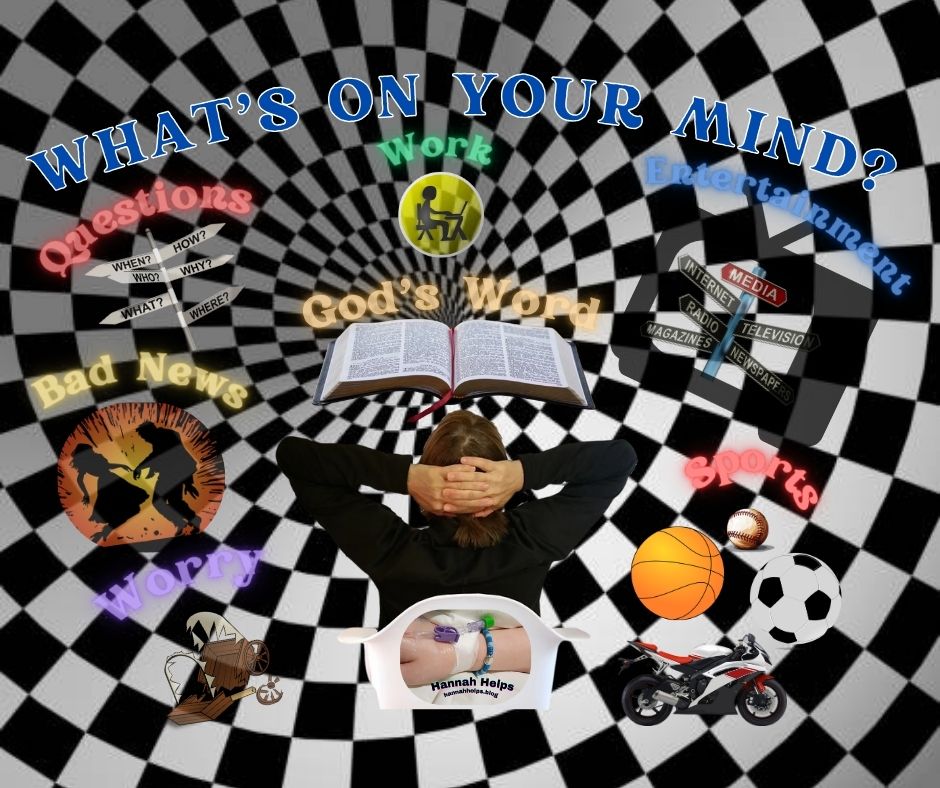
This will be a longer one today. There is a topic that has been on my mind for quite a while. It is something that, in times like these, seems absolutely necessary, and probably one of the hardest disciplines to gain victory in. This is the topic of “mind control”. At first glance, mind control may conjure up ideas of hypnosis or magic tricks, in which someone else theoretically has their mind “controlled” by another. Although the realities of this are highly suspect, there is a mind control that must be considered. That is the control of our own minds. The way in which we think, the things that we allow into our minds, and then the things that we let them spend time dwelling on, are very important. Perhaps a test of this would be to simply spend three to five minutes somewhere quiet and away from distraction. With no radio, tv, or other outward “noise”, where does our mind go? Perhaps a brain “exercise” would be to try to limit our minds to only one thing for the same amount of time. Praying is perhaps a difficult thing, at times, because my mind always wants to run down some rabbit trail instead of focusing only on the needs at hand. Sometimes controlling my mind seems like walking a tight rope. It can be an almost impossible task at times, but if achieved, it will greatly help in all areas of our daily walk-through life.
Maybe we start by considering a few things that influence the way in which we think, I am certain that I will not mention everything, but then again, just remember that I am just a guy sitting on my couch in the wee hours of the morning. I am sure that there are some basic things that affect our thoughts. Things like being hungry, being tired, or even being wound up on caffeine can send our brains into mental gymnastics. Let’s categorize those kinds of things as “physical”. In general, they are things that are just part of our daily life here on earth in these earthly bodies. If I am hungry, it’s hard to think about anything else, anyone who has had kids can understand that a crying baby often times is just tired, and caffeine or other chemicals/drugs can send our minds racing like a pinball, bouncing back and forth in between thoughts almost simultaneously. The physical things that affect our minds can be fairly easily remedied but cannot be overlooked or ignored. Fatigue definitely seems to limit control of my mind.
There is another category that I would like to consider, and that is the area of things that are “brought into” our minds. These would include thoughts that enter through our senses. Each of our senses can evoke ideas that affect the way we think. Although touch, taste, and smell are often “lesser” senses, but yet the smell of a skunk can certainly be distracting. Sight and hearing are much more primary and influential. The things we hear at work, see as we go about the day, and, perhaps, the biggest one can be the things that we entertain ourselves with, each contribute to what we think about. Our minds are always absorbing, processing, and storing information. Some of this can’t be controlled, but there is certainly a lot that we can. Our minds are greatly influenced by the things that we choose to watch or listen to. We need to attempt to control the “input” in order to limit unnecessary or unwanted thoughts. As a child, in kindergarten, I liked the Transformers cartoons. One of the main characters was Bumblebee, who had his voice modulator thing damaged at some point, so he could only communicate by using his radio. Well, that’s how I remember it anyway. That idea of the old-school radio tuner knob scrolling back and forth is somewhat how I envision my mind working. It scrolls back and forth through the stored memories and accesses that information. Some of that is good and some of that is not. Further, please consider that we are not limited to “what’s on the radio”. We also control what goes into the radio, by things such as entertainment. If we control what we allow in, then as a result, we will be controlling or at least limiting the possibilities of unwanted thoughts. Maybe I need another analogy here. Let’s say that we are driving down the road and see something brown and furry partially flattened on the road up ahead. Yes, it’s “roadkill”. Although it has now been identified, there still remains the question. “How closely do I look at this?” We can drive past without a second glance, we can “rubber neck” as we go past to get a “good look”, or we can pull over, get out of the car and really examine that thing up close and personal. Although a silly analogy, I think we can all understand that the more time and attention that we choose to spend will greatly impact the memory in our mind, and to many, the memories made would be disturbing for days to come. In short, if it doesn’t go in, it can’t be a problem later. Or maybe it’s like the powdered doughnuts in my pantry, had they been left at the grocery store, they would not be tempting me now.
One last consideration has to be the thoughts put into our heads more “supernaturally”. I don’t think that this is something that we generally are willing to consider, but it is part of the equation. Often, I have seen in cartoons the “good and bad” angles each sitting on the shoulder of a person (or animal). One says to do right, the other says to do wrong. This is perhaps a little over simplified, but then again, maybe not. On the positive side, we see the work of the Holy Spirit. He convicts the world about sin, righteousness, and judgement. (John 16:8). He comforts and counsels believers. (John 14:16) He guides us. (John 16:13). There are more things, but you get the idea. On the other hand, evil is at work too. There are three primary ways in which it influences our minds. The world, the flesh, and the devil himself. The “world”, in the Bible is a word used to describe the whole system in which we operate. From daily interactions with people, to culture, to the influence of some governments, and even to, again, entertainment, the world, in the Bible, refers to an anti-God system that naturally pulls people away from God with its expansive influence and appeal. The “flesh” is that natural part of us that, perhaps, can be best described as selfish. It wants what it wants and will get it at any cost, and no one is going to tell it what to do or stop it. It’s a part of us that cannot be regenerated and will always choose a selfish, anti-God approach to life. Desires for extravagant wealth, power over others, and inappropriate physical relationships, are a few examples. Finally, Satan himself, like the Holy Spirit, does have the ability to influence our thought life.
I realize that this is getting long, so let’s bring this to a conclusion. With all that has happened with Hannah’s passing, our minds have been racing. There are a myriad of thoughts and memories. There are also thoughts of anger, resentment, and even selfishness, which say, “No one and nothing else matters. I am hurt, I will do and say whatever I want, and I do not care about anyone else”. There are thoughts challenging God and His plan. There are thoughts about how other people perceive our pain. “Do they care? Can they understand? Are they ‘judging me’?” In the end, where I am going with this is that we all need to fortify our minds first by doing things as simple as getting enough rest, then we need to limit the influences that we allow into our lives and minds, then ward off the attacks by Satan himself, and for those of us who believe in Christ, we listen carefully to the Spirit of God inside of us then follow His direction. In Ephesians 6:17, the apostle Paul exhorts us to put on, “the helmet of salvation”. To the believer, salvation is the primary protection in the battle for our minds. It needs to be put on. It can’t be left in a closet or on a shelf. That’s to say, it needs to be constantly in the forefront of our thinking and the primary filter by which we analyze our thoughts. One other passage that I am repeatedly reminded of in this battle is Philippians 4:8. It is not a list of things to do, so to speak, but rather a pattern by which we should think, or perhaps a list of test questions by which we evaluate the thoughts inside us. Are the things on our minds: true, honorable, right, pure, lovely, of good report, excellent, and praiseworthy. There is also a contrasting list of actions given in Galatians 5:19-21 that are identifiers of a life, not yet surrendered and controlled by God. These are thoughts or actions of: immorality, impurity, sensuality, idolatry (putting something else in place of God), sorcery, enmities (opposition or divisions), strife, jealousy, anger, disputes, dissensions, factions, envying, drunkenness, carousing, etc. So a question to ask is, “Are my thoughts beneficial or detrimental to me, and are they beneficial or detrimental to others?”43 If I can control my mind, my life will honor God and others will be positively impacted, for Him, by me.
We are blessed!
 Hannah Helps Blog